Update — May 4, 2026: GitHub has assigned CVE-2026-42868 to this vulnerability. The advisory has been reviewed for compliance with CVE rules and the record will be published to the CVE List once the Security Advisory is published in the global GitHub Advisory Database.
Why this was worth writing about
Most security findings are not memorable because of how complex they are. They are memorable because of how simple they are.
This one was not buried behind a race condition or a deep parser bug. It was a missing authentication check on a scheduler router. A request that should have been rejected was not. That is the kind of finding that matters immediately — it does not require chaining, it does not require specific timing, and it does not require any credentials. The trust boundary is simply gone.
I wanted to document this not just for the finding, but for the process. Responsible disclosure is part of the work. The research is only half of it. The other half is making the issue clear, reproducible, and credible enough that a maintainer can act on it without ambiguity.
What I found
During authorized testing of CoPilot — a SOC automation platform built by SOCFortress — I identified that the scheduler router was not enforcing authentication.
The behavior was straightforward to verify:
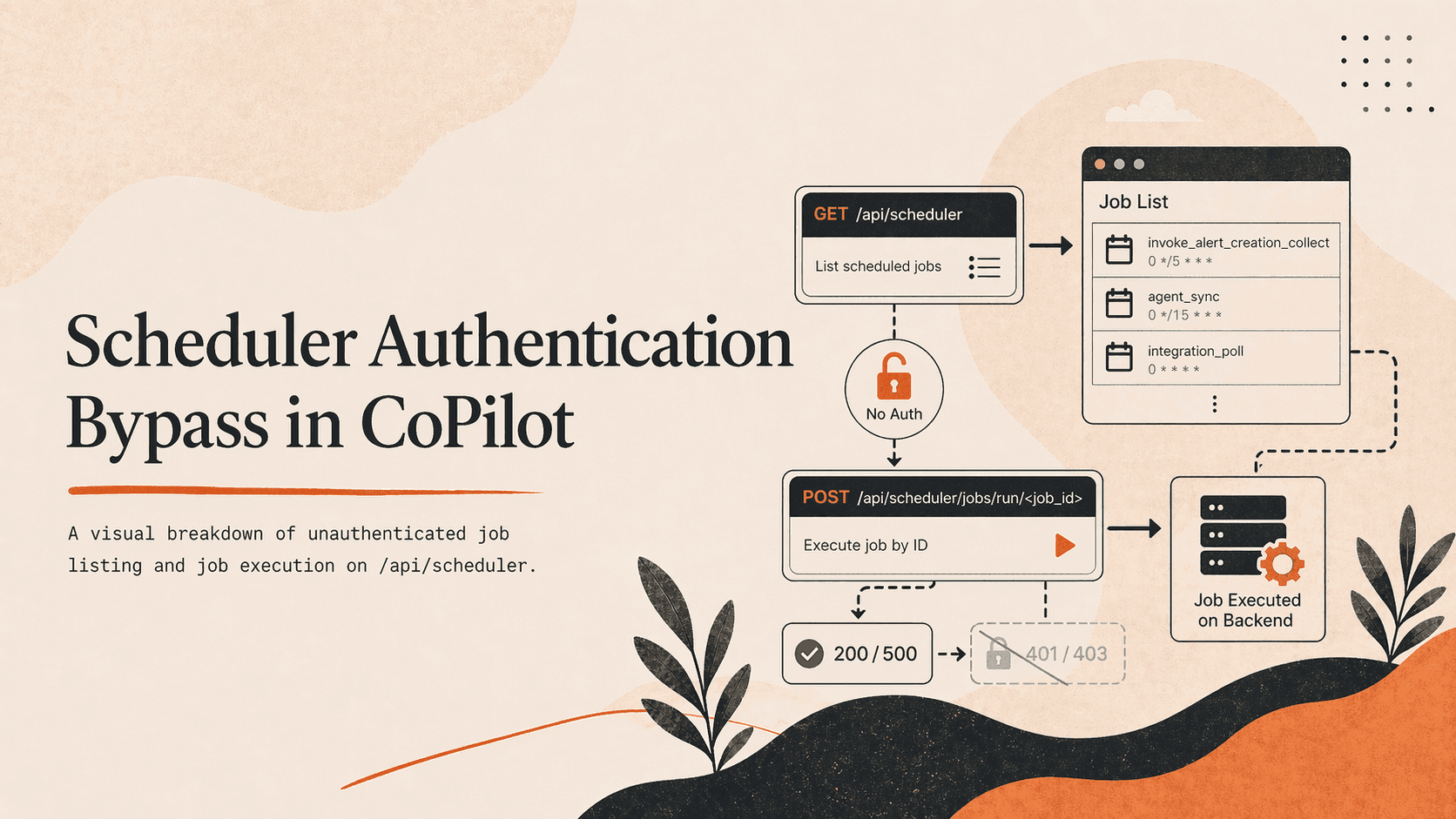
GET /api/schedulerreturned HTTP 200 with full scheduler metadata and noAuthorizationheader requiredPOST /api/scheduler/jobs/run/<job_id>was reachable without authentication- The execution endpoint returned
HTTP 500 Internal Server Error— not401 Unauthorizedor403 Forbidden
That last point is worth dwelling on. A 500 from an unauthenticated request is not a failed auth check — it is a server error that happened after the request passed the authentication boundary and reached execution logic. The route is not protected. The 500 just means the specific job invocation hit an error downstream.
The affected area is backend/app/schedulers/routes/scheduler.py, mounted at /api/scheduler.
Why the issue matters
A scheduler endpoint is not just another API route. It sits close to operational workflows — background jobs, data pipelines, sync tasks, infrastructure-facing logic. In the context of CoPilot specifically, the scheduler manages automated SOC operations: alert ingestion, agent syncs, integration polling.
Unauthenticated read access to /api/scheduler exposes the internal job registry — names, cadence, component relationships. That is operational intelligence an attacker does not need to have.
Unauthenticated write access to the execution endpoint is a different category of risk. Even a partial execution — a job that starts and fails — can cause backend load, trigger unintended automation, or disrupt workflows that downstream systems depend on.
But the larger concern is the pattern. If authentication is missing from the scheduler router, the question that follows immediately is: where else is it missing? Missing auth on one router is rarely an isolated decision. It is usually a gap in how middleware was applied across the codebase.
What the validation looked like
The PoC I built does two things and nothing more:
Enumerate jobs without credentials:
python 02_unauth_scheduler.py --target http://localhost:5000
Attempt unauthorized job execution:
python 02_unauth_scheduler.py --target http://localhost:5000 --run-job invoke_alert_creation_collect
The first command returns the full job list. The second reaches server-side execution logic without an auth challenge. That is enough to confirm the finding. The PoC is kept minimal intentionally — a focused proof of concept is easier to review, harder to dismiss, and does not overreach what the evidence actually supports.
The full PoC is available at: github.com/Chimppppy/copilot-unauth-scheduler-poc
Writing the report precisely
One discipline I care about in disclosure work is not writing more than the evidence supports.
It would be easy to headline this as "unauthenticated remote code execution." It sounds sharper. It would also be wrong. What the evidence shows is:
- Unauthenticated access to the scheduler listing endpoint: confirmed
- Unauthenticated invocation of scheduler jobs reaching execution logic: confirmed
- Successful completion of a scheduler job from an unauthenticated request: not yet conclusively proven from the captured
500response
That distinction matters. Credibility in security research comes from being exact. Overstating a finding does not make it more serious — it makes it easier to dismiss, and it makes the researcher easier to ignore.
The report was structured to be immediately actionable:
- concise summary with affected endpoints
- exact HTTP responses observed
- reproduction steps
- scoped impact
- remediation direction
- a PoC repository that anyone can run against their own deployment
Responsible disclosure and outcome
After validating the issue I filed a private GitHub Security Advisory against the CoPilot repository and published a separate PoC repository for documentation purposes.
The goal was not to publish noise. It was to create a clean, formal record that a maintainer or CVE reviewer could evaluate without needing to ask follow-up questions. A well-scoped report moves faster through the disclosure process than a dramatic one.
The disclosure timeline played out as expected:
- Private advisory filed against the CoPilot repository
- Maintainer (taylorwalton) reviewed and accepted the report
- Patch developed and merged (commit
7d5917b) - Maintainer requested a CVE through GitHub's CNA
- GitHub assigned CVE-2026-42868 on May 4, 2026
- Advisory and PoC are now public record
The advisory tracks as GHSA-cx3g-ffv9-4gwg and CVE-2026-42868, classified High severity.
What I took away from it
The biggest lesson from this kind of work is that strong security research is about discipline as much as discovery.
Finding the issue is the start. Reporting it in a way that is technically honest, well-scoped, and immediately useful to the people who need to fix it — that is what determines whether it actually gets fixed.
If the evidence shows an unauthenticated path, say that clearly. If job execution may have triggered but the response was ambiguous, say that clearly too. The report has to stand on its own. It will be read by people who were not in the room when the finding happened, and they will form their own judgment about whether it is credible.
Being exact is the only way to ensure that judgment lands correctly.